A missed letter can create bigger problems than most founders expect. Tax notices, bank letters, court mail, insurance documents, and customer correspondence still arrive on paper. If you run your business remotely, travel often, or do not want to publish your home address, the question becomes practical fast: wie funktioniert digitale Postweiterleitung, and when is it the right setup for a real business?
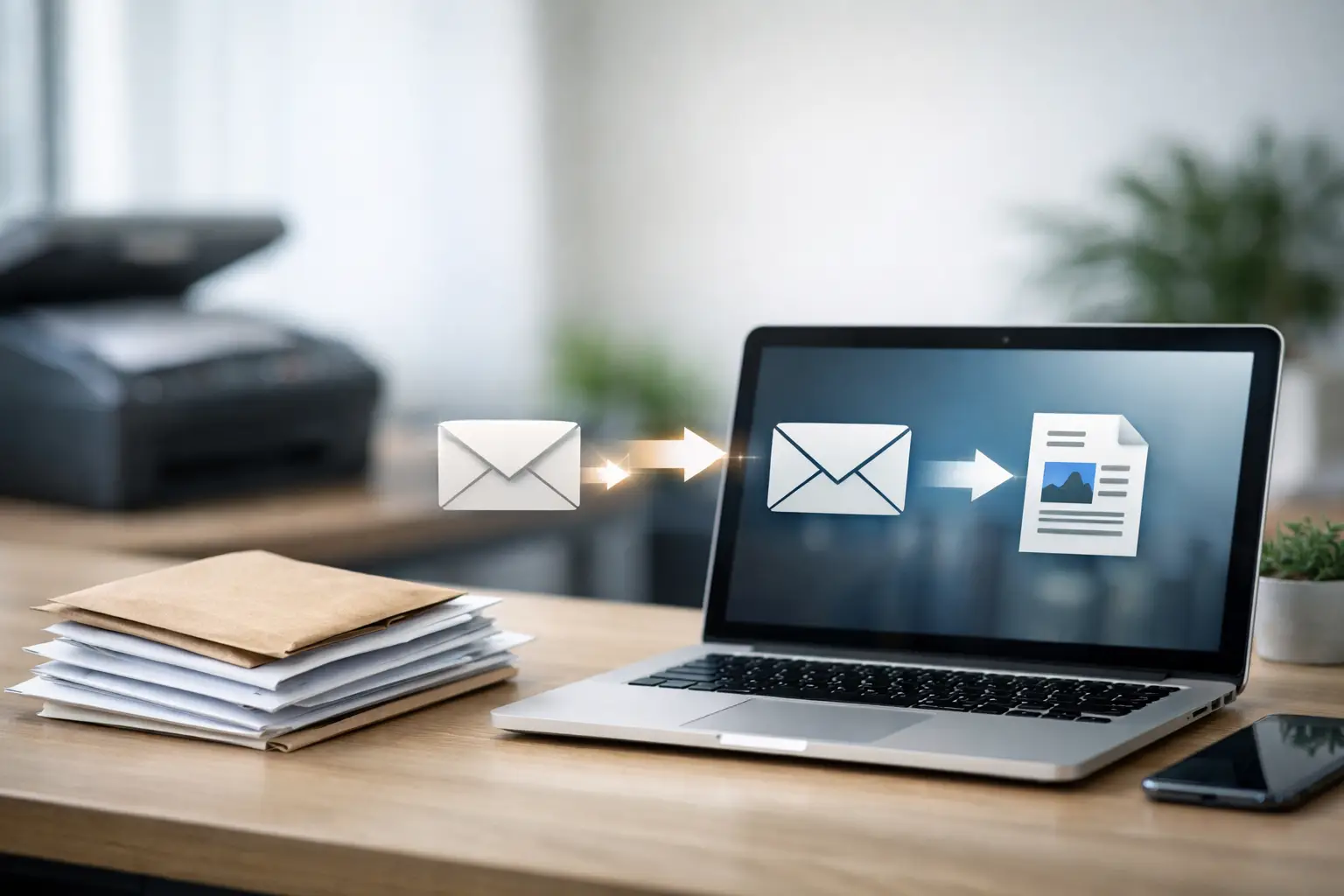
Digital mail forwarding is a service tied to a physical business address. Your business mail is received at that address, logged, and then processed according to your authorization. In most cases, that means the envelope is identified, the contents are scanned, and the documents are made available digitally so you can review them without being on site. Depending on the service, original letters can also be stored, physically forwarded, or prepared for pickup.
For founders and small companies, the value is not just convenience. It is control. You know where business mail arrives, who handles it, how quickly you can access it, and whether the process fits legal and privacy requirements.
How does digitale Postweiterleitung work in practice?
The process starts with a real, staffed business location. That point matters because digital mail forwarding is not simply an app feature. Someone has to receive physical mail at a legitimate address, sort it correctly, and process it under clear rules.
Once your company uses that address for business correspondence, incoming letters are accepted on your behalf. The provider records the arrival and checks what type of item it is. Standard business mail is usually eligible for digital processing. After that, the contents are scanned and sent to you through a secure digital channel or customer dashboard, depending on the setup.
At that stage, you decide what happens next. Some businesses only need digital access because they archive records electronically and act on documents immediately. Others want originals forwarded weekly or monthly to another office. In some cases, physical storage for a limited time is enough.
That is the basic answer to wie funktioniert digitale Postweiterleitung: mail is physically received, digitally captured, and then managed according to a defined workflow.
What actually gets scanned and forwarded?
This depends on the provider, the authorization you give, and the type of mail involved. Regular business letters are usually straightforward. If a supplier invoice, contract, insurance notice, or administrative letter arrives, it can normally be opened, scanned, and uploaded for you.
There are limits, and serious providers are clear about them. Parcels are a different operational category than letters. Registered mail may require special handling. Some official documents may need physical delivery or personal acknowledgment depending on the sender and the legal context. A compliant provider will explain these boundaries upfront rather than implying that every item can be treated the same way.
That distinction matters for risk management. If you choose digital forwarding for your business address, you want to know not only what is possible, but also what still requires physical handling.
Why businesses use digital mail forwarding
For freelancers and early-stage companies, the first reason is often privacy. Using a home address for public business records can feel unprofessional and, in many cases, simply impractical. A separate business address gives the company a cleaner setup and keeps personal and business correspondence apart.
The second reason is speed. If you are working from different locations or spending time with clients, waiting for physical forwarding adds delay. A scanned letter can be reviewed the same day, assigned internally, and acted on quickly.
The third reason is operational consistency. When all business mail goes to one place, handling becomes easier to track. That helps when multiple founders, finance staff, or external advisors need visibility. It also reduces the risk of documents getting lost between a private mailbox, a coworking desk, and a temporary office.
Compliance matters more than the feature list
Many businesses look at digital mail forwarding as an admin shortcut. It is useful, but the bigger issue is whether the address and process are legally and operationally sound.
In Germany, a business address used for imprint, registration, or official communication has to meet real-world standards. A provider should offer actual physical premises, structured mail handling, and GDPR-compliant processes. That is especially relevant if sensitive customer data, financial documents, or legal correspondence may pass through the workflow.
A low-cost mailbox solution can look similar on the surface, but it may not offer the same legal usability or administrative reliability. That is where many founders make the wrong comparison. The key question is not just whether mail can be scanned. The question is whether the underlying address and handling process are appropriate for serious business use.
Wie funktioniert digitale Postweiterleitung for a virtual business address?
When digital mail forwarding is connected to a virtual business address, the service becomes more than a convenience layer. It turns the address into an active administrative base for the company.
Your business uses the address for correspondence, and the provider manages incoming mail according to your instructions. You do not need to be present to monitor letters, and you do not need to expose your private address to clients, vendors, or public listings. For many remote founders, this is the missing piece between running lean and still appearing fully established.
The advantage is strongest when the provider combines address services with real office infrastructure. If you later need meeting rooms, day offices, private offices, or a place to work on site, you are not changing systems. You are building on the same operational base.
TowrHub offers this type of setup in Darmstadt with a legally usable business address, mail handling, and workspace options for companies that want flexibility without improvising their admin. Website: https://buero-darmstadt.de
If you want to set up a business address with mail handling, use this page: Jetzt einrichten: https://buero-darmstadt.de/geschaeftsadresse/
What to check before choosing a provider
The first point is whether the address is genuinely suitable for business use. If you need an address for imprint purposes, business registration, or general company communication, ask direct questions about legal usability instead of assuming all virtual address products are equivalent.
The second point is process clarity. You should know how mail is received, when it is scanned, how you are notified, how long originals are stored, and what happens with special items. Vague answers usually lead to operational friction later.
The third point is data handling. Scanned business mail often contains invoices, IDs, contracts, and customer information. GDPR-compliant processing, controlled access, and documented handling procedures are not optional details.
The fourth point is scalability. A freelancer may only need a business address today, but a growing company may need desks, meeting rooms, or private office space later. Choosing a provider that can support both stages saves time and avoids another address change.
Common misunderstandings about digital mail forwarding
One common misunderstanding is that digital mail forwarding replaces all physical mail. It does not. Some documents still need original retention, physical delivery, or special handling.
Another is that any digital mailbox is automatically compliant for official business use. It depends on the provider, the premises, and the service structure behind the address.
A third is that this service is only for digital nomads or online businesses. In reality, consultants, agencies, trades, import-export businesses, holding companies, and local service firms all use digital forwarding when they want a professional address and centralized mail handling without leasing a conventional office full time.
Is digital mail forwarding right for your business?
If your company receives important business mail but you do not want to manage it from a home address, digital forwarding is often the practical next step. It works especially well for founders who travel, remote teams without a fixed office, and small companies that want a credible address before taking on permanent office overhead.
It may be less suitable if your business depends heavily on daily parcel intake, large-format deliveries, or high volumes of physical originals that must stay on site. In that case, a dedicated office reception setup may be the better fit.
The right decision usually comes down to volume, document sensitivity, and legal use case. If the address must support a serious business presence and the mail process must be reliable, choose the provider the same way you would choose accounting or legal infrastructure – based on compliance, transparency, and operational trust.
A good mail setup does not make your business look bigger than it is. It makes the business easier to run, which is usually the smarter goal.